Flood Damage Restoration in Bakersfield
24/7 flood damage restoration in Bakersfield and surrounding areas. IICRC-certified, insurance billing accepted. Call (661) 393-9306.
Flood water doesn’t stop at the threshold. Whether a Kern River overflow, a ruptured municipal main, or a backed-up storm drain pushed water into your home, the clock starts the moment it enters — and mold can begin colonizing porous materials in as little as 24 to 48 hours. The difference between a contained repair and a gut-and-rebuild often comes down to how fast contaminated water is extracted and how thoroughly the structure is dried behind the walls and under the subfloor, not just on the surface.
What flood damage restoration actually involves
Flood cleanup is not the same as mopping up a burst pipe. Floodwater is almost always classified as Category 3 — “black water” in the IICRC S500 standard — because it has contacted soil, sewage, or outdoor contaminants before entering your home. That classification changes everything: affected materials like carpet, pad, and drywall below the flood line typically cannot be dried in place; they have to come out. Porous materials that have absorbed Category 3 water are considered contaminated regardless of how clean the water looked.
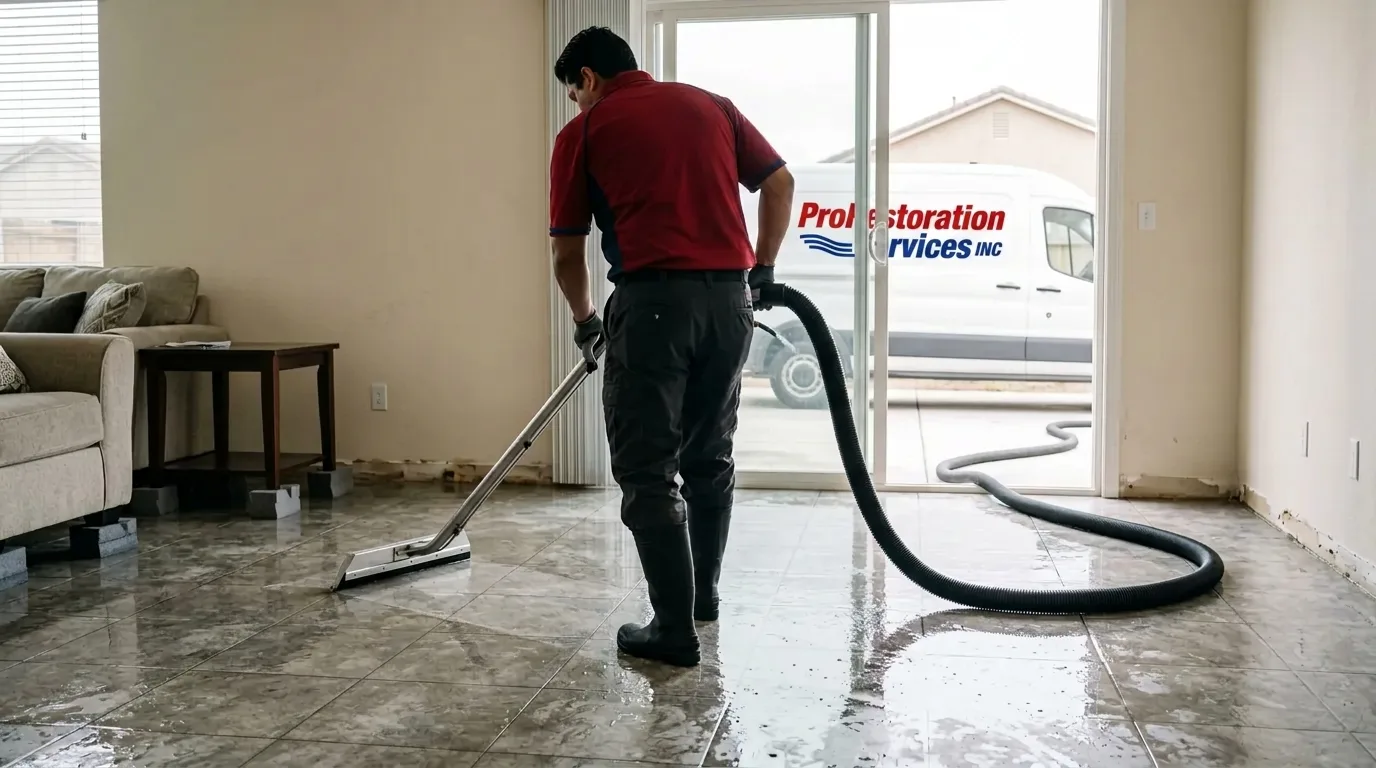
The equipment involved goes well beyond a shop vac. Industrial truck-mounted or portable extractors remove standing water. High-velocity air movers accelerate evaporation from structural cavities. Refrigerant or desiccant dehumidifiers pull moisture-laden air out of the drying zone. Thermal imaging cameras and penetrating moisture meters map saturation in wall cavities, subfloor assemblies, and ceiling joists that look dry to the eye but aren’t. The drying phase typically runs three to five days under active monitoring, though concrete slabs and dense framing lumber can extend that timeline.
Our process
-
Emergency water extraction and safety assessment. The moment we arrive, we identify the water source, confirm it’s controlled, and assess structural safety before anyone enters. Standing water is extracted using truck-mounted or portable high-capacity extractors. We also document the water category and the extent of intrusion — photographs, moisture readings, and a written scope — which your insurance adjuster will need.
-
Contaminated material removal. Category 3 flood events require removing saturated drywall (typically 12–18 inches above the flood line), soaked insulation, carpet, pad, and any other non-salvageable porous materials. This step is non-negotiable for a safe dry-out; leaving contaminated drywall in place traps moisture and creates the conditions for rapid mold growth.
-
Antimicrobial treatment and structural drying. After demo, affected framing, subfloor, and concrete are treated with EPA-registered antimicrobial agents. Air movers and dehumidifiers are positioned to create a controlled drying system — not just pointed at wet spots, but engineered to move air through cavities. Moisture readings are logged daily against a drying goal tied to the local equilibrium moisture content for Bakersfield’s climate.
-
Moisture verification and clearance. Drying is not complete when the surface feels dry. We use penetrating meters and thermal imaging to confirm that wall cavities, subfloor assemblies, and slab edges have reached acceptable moisture levels before any reconstruction begins. A written moisture log documents the drying curve from day one to clearance — something a quality insurance adjuster will ask for.
-
Reconstruction coordination. Once the structure passes clearance, we coordinate or perform the rebuild: drywall, insulation, flooring, painting, and finish work. Having the same team handle both the mitigation and the rebuild eliminates the handoff gap where damage often gets missed or underbid.
What separates a good flood response from a bad one
The most common failure in residential flood damage repair is incomplete extraction followed by cosmetic drying. A contractor who runs a few air movers for two days and declares the job done may leave moisture readings above 20% in wall framing — enough for mold to establish within a week. By the time the homeowner smells it, the remediation cost has doubled.
A second common miss is underestimating the flood line. Water wicks upward through drywall via capillary action, often reaching 6–12 inches above the visible waterline. Cutting demo at the visible stain and leaving the wet material above it is a mistake that shows up in reinspection.
Insurance adjusters on flood claims look for a moisture log that shows daily readings at multiple points, a clear water category determination with documentation, and a demo scope that matches the moisture map — not a flat “tear out everything” or a “dry it in place” that doesn’t match the category. Thorough documentation is what gets a claim approved at the right number.
Seasonal and regional considerations
Bakersfield sits in the southern San Joaquin Valley, where the dry climate can create a false sense of security after a flood event. Low ambient humidity means surface materials dry faster — but that same dry air can mask moisture trapped in dense materials like OSB subfloor or concrete block foundations, leading crews to pull equipment too soon. During winter atmospheric river events, which have become more frequent and severe in the Central Valley, storm drains and retention basins can back up quickly, pushing water into slab-on-grade homes that have no crawl space buffer. Those slab foundations hold moisture longer than wood-framed floors and require extended drying cycles. Spring irrigation season also brings elevated groundwater in some Bakersfield neighborhoods, which can contribute to seepage through foundation walls even without a direct flood event.
Service area
ProRestoration Services responds to flood damage throughout Bakersfield and the surrounding communities, including Oildale, Rosedale, Shafter, Wasco, Delano, Tehachapi, and Ridgecrest. City-specific pages detail local considerations for each area and link back here for the full process overview.
If your home or building took on floodwater — from a storm, a sewer backup, or a rising waterway — call (661) 393-9306 now. Our IICRC-certified team is available 24/7, and the sooner extraction begins, the narrower the scope of damage. Start your flood damage assessment today.
Frequently Asked Questions
What is Category 3 water, and why does it change what materials can be saved?
How high above the waterline does flood damage actually extend?
What should I do — and not do — while waiting for the restoration crew to arrive?
How does flood damage documentation affect an insurance claim, and what does a good moisture log include?
Why does structural drying sometimes take longer in slab-on-grade homes common in Bakersfield?
Looking for the best flood damage restoration company in Bakersfield?
ProRestoration Services provides licensed and insured flood damage restoration in Bakersfield, CA and the surrounding area. We answer calls 24/7 — call (661) 393-9306 for immediate help.
Need Flood Damage Restoration now?
We respond 24/7 across Bakersfield and surrounding CA cities.
Related Coverage
- Our Restoration Services
- Contact ProRestoration Services
- Flood Damage Restoration in Arvin
- Flood Damage Restoration in Bakersfield
- Flood Damage Restoration in Delano
- Flood Damage Restoration in Lake Isabella
- Flood Damage Restoration in Lamont
- Flood Damage Restoration in Oildale
- Flood Damage Restoration in Rosedale
- Flood Damage Restoration in Shafter
- Flood Damage Restoration in Taft
- Flood Damage Restoration in Tehachapi
- Flood Damage Restoration in Wasco