Flood Damage Restoration in Taft
24/7 flood damage restoration in Taft, CA. IICRC-certified, insurance billing accepted. Call (661) 393-9306.
Our IICRC-certified technicians are dispatched from our Bakersfield, CA headquarters and are typically on-site in Taft within 60 minutes of your call.
Taft sits at the dry edge of the San Joaquin Valley, where summer heat bakes the soil into a near-impermeable crust and the older housing stock in Ford City and South Taft was built for oil-field workers who never expected a burst galvanized supply line to dump 40 gallons an hour under a hardwood floor. When that happens — or when a rare winter storm backs up an undersized drain — the damage moves fast and the window to prevent secondary mold growth is short. ProRestoration Services responds to flood losses in Taft 24 hours a day, seven days a week, dispatching from Bakersfield the moment you call (661) 393-9306.
Why Taft Properties See Flood Damage More Than You’d Expect
The West Side’s oil-boom era left Taft with a distinctive housing problem: a large share of the cottages in Ford City and along the streets radiating south toward South Taft were constructed between the 1920s and 1950s. Galvanized steel water supply lines installed in that era have a service life of roughly 40–70 years. Many of those pipes are now well past it. Corrosion narrows the interior diameter over decades, pressure spikes crack the weakened walls, and the failure often happens inside a wall cavity or below a slab — invisible until water is already wicking into subfloor framing.
Compounding the risk, those same homes were built with wall furnaces and minimal interior drainage slope. A slow leak behind a furnace chase can saturate insulation and floor joists for weeks before a homeowner notices discoloration on baseboards. By that point, the moisture content in structural wood is often high enough to support mold colonization within 24 to 48 hours of the initial event — a timeline the IICRC S500 standard treats as the critical intervention window.
Taft’s desert-edge climate does offer one genuine advantage for restoration: low ambient humidity accelerates structural drying significantly compared to coastal California markets. A properly set drying system in a Taft home can reach target moisture levels in fewer days than the same job in Fresno or Bakersfield’s valley floor. The catch is wind-driven dust. On high-wind days along the Highway 33 corridor, fine particulate infiltrates flood-affected contents and requires additional cleaning steps before pack-out or on-site restoration.
Our Flood Damage Restoration Process in Taft
Every flood loss is different, but the sequence for older Taft homes follows a consistent logic shaped by the local building stock.
Arrival and safety assessment. Before any equipment goes in, the crew confirms utility shutoffs — gas is a particular concern in homes with original wall furnaces — and checks for standing water near electrical panels, which in pre-1960 construction are sometimes located in utility closets adjacent to water heaters.
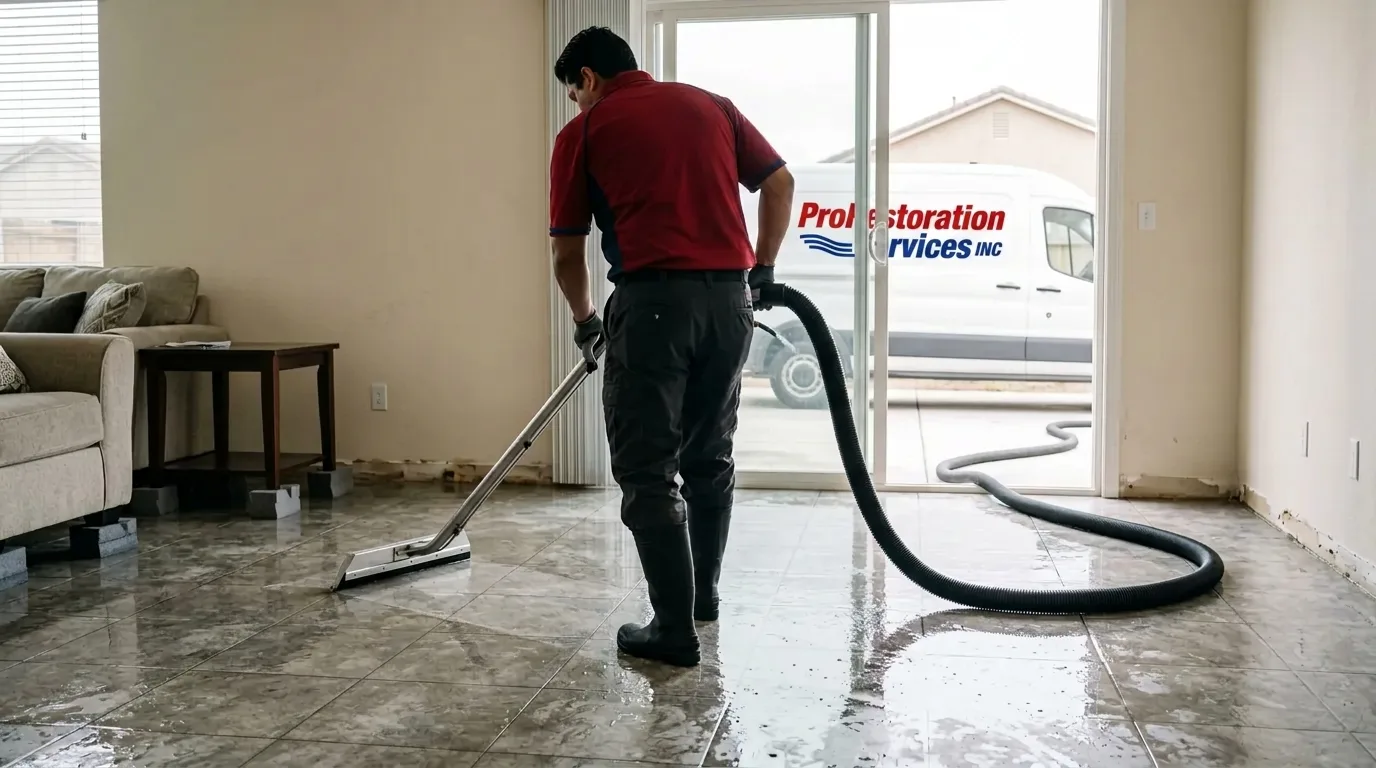
Extraction. Truck-mounted and portable extractors pull standing water from hard surfaces and carpet. In homes with original tongue-and-groove hardwood or vinyl composition tile over concrete slab — both common in Ford City — the extraction approach is calibrated to avoid damaging flooring that may still be salvageable.
Moisture mapping and documentation. Thermal imaging cameras and calibrated moisture meters map the full extent of saturation, including wall cavities and subfloor assemblies. This documentation is critical for insurance claims and establishes the baseline for drying goals.
Controlled demolition (when necessary). Saturated drywall, insulation, and damaged flooring are removed to the flood cut line. In homes with original plaster walls — still present in a number of Downtown Taft properties — the drying protocol differs; plaster releases moisture more slowly than drywall and may require extended drying cycles and additional monitoring visits.
Drying and dehumidification. Commercial-grade desiccant and refrigerant dehumidifiers run continuously. Given Taft’s low ambient humidity, drying timelines are often shorter than regional averages, but daily moisture readings confirm progress before equipment is removed.
Antimicrobial treatment and clearance. Affected structural surfaces receive EPA-registered antimicrobial treatment. The job is not closed until final moisture readings confirm materials have returned to acceptable levels.
Getting to Taft from Bakersfield
The ProRestoration Services crew drives Highway 119 west out of Bakersfield, picking up Highway 33 south into Taft — a route that runs roughly 35 miles and reaches the 93268 ZIP code in under an hour under normal conditions. That puts the crew on-site faster than most restoration companies that cover the West Side from Fresno or the coast. Calls received any hour of the day or night are dispatched immediately; there is no answering service delay or next-morning callback.
For addresses near Taft College or along the Rails to Trails path corridor, the crew enters from North Street to avoid the heavier truck traffic on Center Street during school hours. For South Taft addresses farther down the 33, the dispatcher notes the additional drive time and coordinates a direct call to the homeowner to confirm access before arrival.
Local Note
One pattern that surprises homeowners in Ford City and South Taft: the original cast-iron drain lines in 1930s–1950s cottages frequently have undersized cleanouts or no accessible cleanout at all. When a flood loss is caused by a sewer backup rather than a supply-line failure, the source of the backup can be difficult to confirm without a camera inspection — and if the line is partially collapsed under the slab, restoration work has to be sequenced around the plumbing repair rather than run concurrently. ProRestoration coordinates directly with licensed plumbers familiar with West Side construction so that drying and reconstruction don’t have to start over after a hidden drain failure is discovered mid-project.
If you are dealing with standing water, soaked walls, or the musty early warning of moisture damage anywhere in Taft, call (661) 393-9306 now. The crew is available around the clock, the documentation starts on arrival, and the goal from the first hour is to protect as much of your home as possible while giving your insurance claim the evidence it needs.
Flood Damage Restoration in Taft: Service Coverage
Frequently Asked Questions
How fast can you arrive for flood damage restoration in Taft?
How quickly can ProRestoration Services reach a flood emergency in Ford City or South Taft?
Are the older cottages in Ford City at higher risk for hidden flood damage?
Does Taft's desert climate affect how long flood drying takes?
What happens if my Taft home has original plaster walls instead of drywall?
How does ProRestoration handle insurance documentation for flood losses in Taft?
Flood Damage Restoration response in Taft
Most Taft calls see a technician on-site within 60 minutes from our Bakersfield headquarters.