Mold Remediation in Bakersfield
24/7 mold remediation in Bakersfield and surrounding areas. IICRC-certified, insurance billing accepted. Call (661) 393-9306.
You might notice it first as a musty smell behind the drywall — or as a dark stain spreading from a corner where a pipe sweated all summer. Mold can colonize wet building materials in as little as 24 to 48 hours, and once it takes hold in insulation, subflooring, or wall cavities, surface cleaning alone won’t stop it. Mold remediation is the process of containing the growth, removing contaminated materials to industry-defined clearance standards, and restoring air quality so the problem doesn’t return in six months.
What mold remediation actually involves
Mold remediation is not the same as mold removal — a term that implies you can simply wipe a surface clean. True remediation addresses the source moisture, the affected building materials, and the airborne spore load simultaneously.
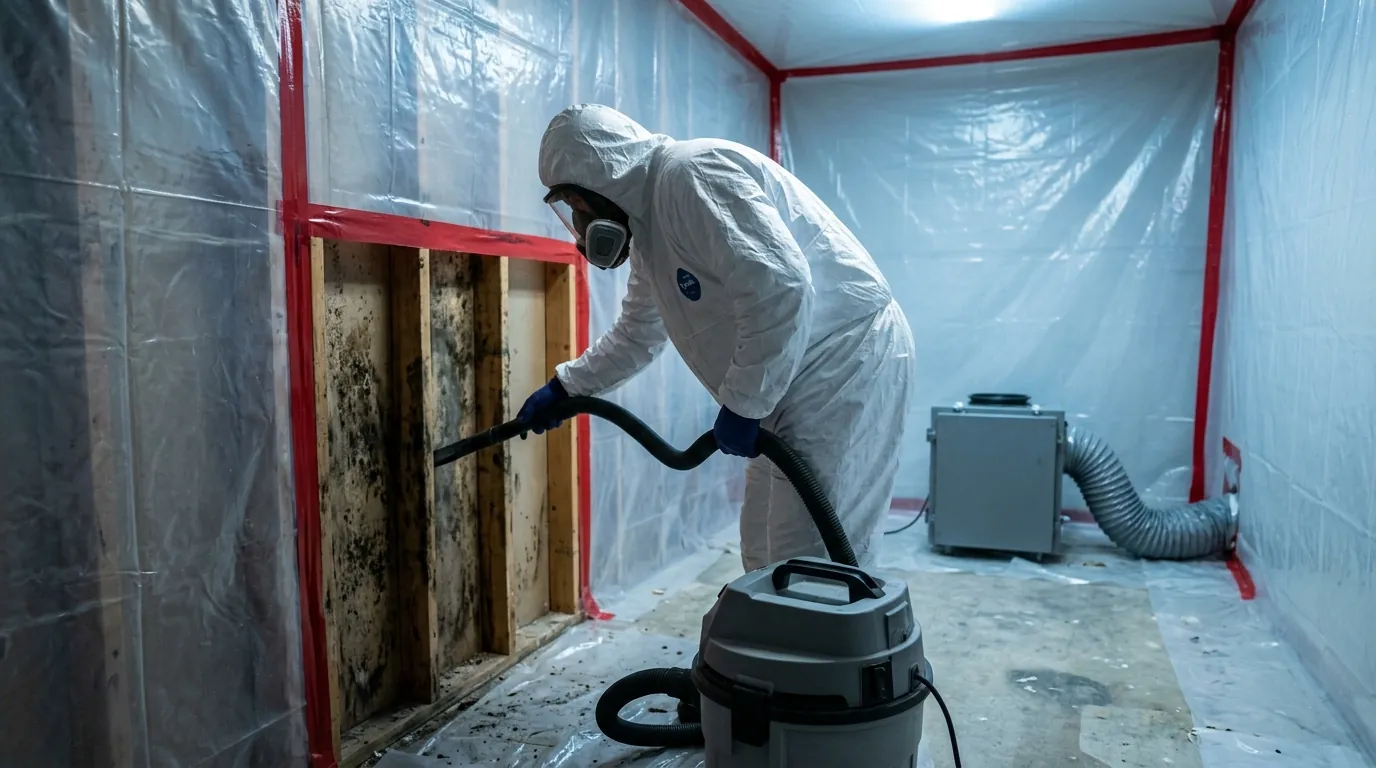
The work typically involves establishing negative-air containment zones with 6-mil poly sheeting and zipper doors, running commercial HEPA air scrubbers rated at 500–2,000 CFM to capture airborne spores during demo, and physically removing porous materials — drywall, insulation, OSB, carpet — that exceed remediation thresholds under the IICRC S520 standard. Non-porous surfaces (concrete, metal studs, tile) can often be cleaned in place using HEPA vacuuming followed by an EPA-registered antimicrobial treatment.
Timeline varies by scope. A single bathroom with minor growth behind a tile surround might be resolved in one to two days. A crawlspace or attic with widespread colonization — common in Bakersfield homes where a slow roof leak or HVAC condensation goes undetected through a dry season — can run three to five days before clearance testing confirms the space is ready for reconstruction.
Our process
-
Inspection and moisture mapping. Before any containment goes up, a technician walks the structure with a pin-type moisture meter and a thermal imaging camera to trace active moisture pathways. Mold visible on one wall often signals hidden growth two or three cavities away. Skipping this step is how remediation jobs come back.
-
Containment and negative air pressure. Affected areas are isolated from the rest of the building using poly barriers and zipper-door entries. A negative-air machine exhausts filtered air to the exterior, keeping spores from migrating into clean zones during demolition. This step is non-negotiable for any growth that extends beyond a 10-square-foot area.
-
Controlled demolition and HEPA vacuuming. Contaminated drywall, insulation, and flooring are cut back to visually clean, structurally sound material — typically 12 to 24 inches beyond the visible growth boundary. All debris is double-bagged in 6-mil poly before leaving the containment zone. Remaining framing and structural members are HEPA-vacuumed, then treated with an EPA-registered antimicrobial agent.
-
Air sampling and clearance testing. Post-remediation air samples are collected inside the former containment zone and compared against outdoor baseline samples. Spore counts and species must fall within acceptable thresholds before containment comes down. This is the step that separates a documented remediation from a cleanup — and it’s what your insurance adjuster and any future buyer’s inspector will look for.
-
Source correction and drying. If the moisture source hasn’t been fixed — a leaking supply line, a failed vapor barrier, a blocked gutter — mold will return. We identify the source during inspection and coordinate repair before or alongside remediation so you’re not back in the same position in a year.
What separates a good mold remediation response from a bad one
The most common failure point is inadequate containment. Contractors who skip negative-air pressure or use lightweight plastic sheeting can spread spores throughout an HVAC system during demo — turning a localized bathroom problem into a whole-house air quality issue. A second common mistake is treating only what’s visible. Mold grows toward moisture; if you don’t follow the moisture, you leave active colonies behind walls.
On the documentation side, insurance adjusters handling mold claims under a sudden-and-accidental water damage provision want to see pre- and post-remediation air sample reports, a moisture log showing readings at the time of discovery, and a photo record of all removed materials. Without that paper trail, supplement claims and coverage disputes become much harder to resolve.
Finally, watch for contractors who apply antimicrobial coatings as a substitute for physical removal. Encapsulation has a limited role in remediation — it’s appropriate for certain structural wood surfaces after cleaning — but it is not a replacement for removing contaminated porous materials.
Seasonal and regional considerations
Bakersfield’s climate creates a specific mold risk pattern that’s different from coastal California. The San Joaquin Valley’s hot, dry summers keep outdoor humidity low, which can mask a slow indoor moisture problem — a dripping supply line or a condensation issue on an oversized AC system — until growth is already established inside a wall cavity. Then the mild, occasionally wet winters bring enough ambient humidity to accelerate colonization in crawlspaces and attics that lack adequate vapor barriers.
Homes built before 1980 in older Bakersfield neighborhoods like Oleander-Sunset and the East Side often have original insulation and minimal crawlspace ventilation — conditions that make mold remediation more involved and make early detection more valuable.
Service area
ProRestoration Services is based in Bakersfield and handles mold remediation throughout Kern County, including Tehachapi, Delano, Shafter, Wasco, and Ridgecrest. Individual service-area pages cover the specifics of each city. If you’re outside Bakersfield proper, call (661) 393-9306 to confirm coverage before scheduling.
If you’re seeing discoloration, smelling something musty, or recovering from a recent water loss, don’t wait for visible growth to spread. Call (661) 393-9306 or request an air quality test online — an IICRC-certified technician will assess the space, map the moisture, and give you a clear picture of what remediation actually requires.
Frequently Asked Questions
What level of mold growth requires full containment with negative air pressure?
What does post-remediation clearance testing actually measure, and who should conduct it?
Can mold grow back after professional remediation?
Is the black mold in my bathroom the same as the toxic "black mold" people talk about?
What should I do — and not do — while waiting for a mold remediation crew to arrive?
Looking for the best mold remediation company in Bakersfield?
ProRestoration Services provides licensed and insured mold remediation in Bakersfield, CA and the surrounding area. We answer calls 24/7 — call (661) 393-9306 for immediate help.
Need Mold Remediation now?
We respond 24/7 across Bakersfield and surrounding CA cities.
Related Coverage
- Our Restoration Services
- Contact ProRestoration Services
- Mold Remediation in Arvin
- Mold Remediation in Bakersfield
- Mold Remediation in Delano
- Mold Remediation in Lake Isabella
- Mold Remediation in Lamont
- Mold Remediation in Oildale
- Mold Remediation in Rosedale
- Mold Remediation in Shafter
- Mold Remediation in Taft
- Mold Remediation in Tehachapi
- Mold Remediation in Wasco
- How To Choose a Restoration Company in Bakersfield (Without Getting Burned)
- How To Test for Mold in Your Home (DIY Kits vs a Pro Inspection)
- 7 Signs You Have Hidden Mold (and What To Do Next)