Mold Inspection and Testing in Bakersfield
24/7 mold inspection and testing in Bakersfield and surrounding areas. IICRC-certified, insurance billing accepted. Call (661) 393-9306.
You notice a musty smell every time the HVAC kicks on, or a family member’s allergies have been worse since a pipe leaked behind the bathroom wall six months ago. The problem with mold is that by the time you can see it, you usually can’t see all of it. Mold inspection and testing answers the question that surface-level observation never can: where exactly is the contamination, how far has it spread, and what species are you dealing with — because that determines everything about what happens next.
What mold inspection and testing actually involves
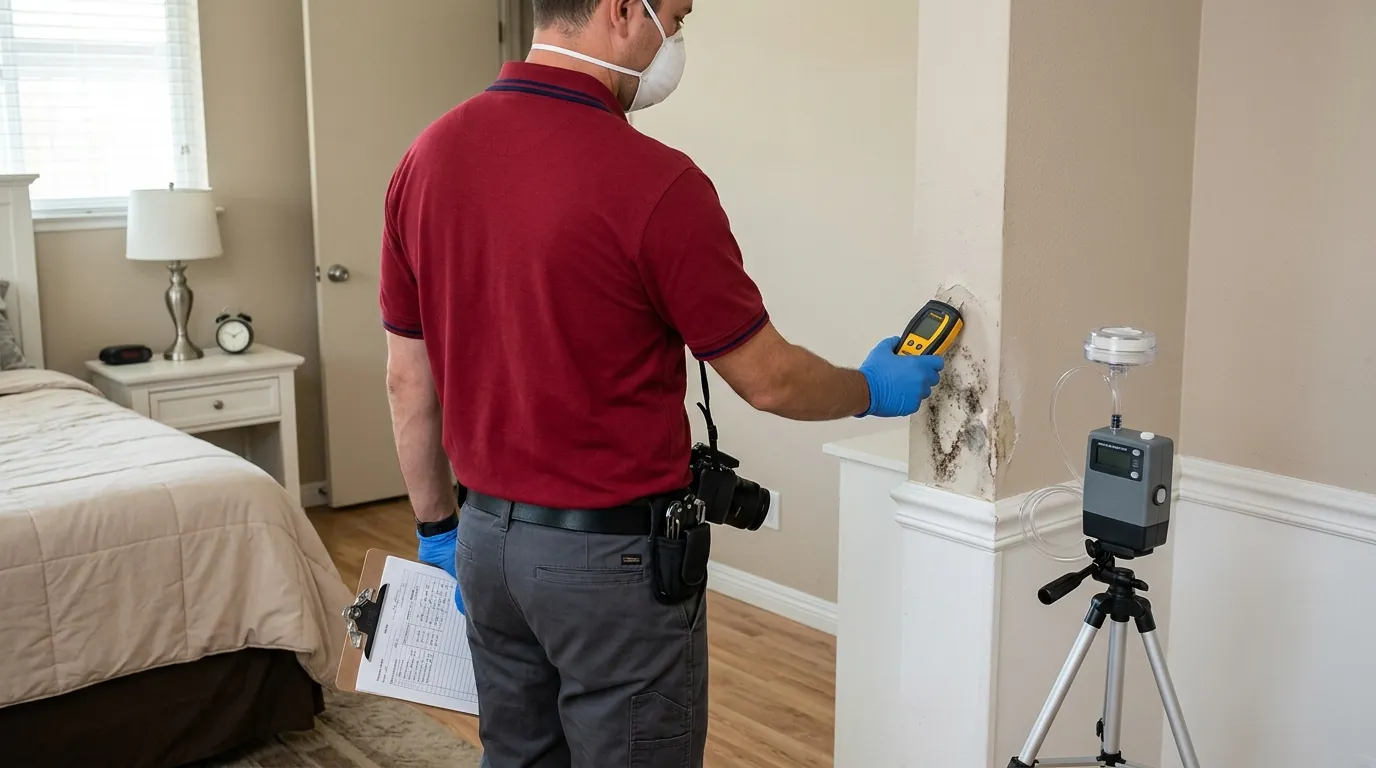
A mold inspection is not a visual walk-through with a flashlight. A thorough assessment combines moisture mapping, thermal imaging, and air and surface sampling to build a complete picture of contamination — including colonies hidden inside wall cavities, under flooring, or in HVAC ductwork where no one would think to look.
Moisture mapping uses calibrated pin and pinless meters to trace elevated readings back to their source. Thermal imaging can reveal temperature differentials behind drywall that indicate wet framing or insulation — the kind of concealed moisture that feeds mold for months before a stain appears on the surface. Air sampling captures what you’re actually breathing: spore counts are measured in spores per cubic meter, and results are compared against an outdoor baseline sample taken the same day so the data reflects your specific conditions, not a generic average.
Surface sampling — tape lifts or swabs from visible growth — identifies the genus and species present. That distinction matters. Stachybotrys chartarum (commonly called black mold) requires different containment protocols than Cladosporium or Penicillium/Aspergillus, and an insurance adjuster reviewing your claim will want that documentation. Lab analysis typically returns results within 24–72 hours through an accredited third-party laboratory, keeping the testing process independent and legally defensible.
The full assessment generally takes two to four hours on-site depending on property size, with a written report delivered once lab results are confirmed.
Our process
-
Pre-inspection interview and history review. Before any equipment comes out, we ask about the building’s water history — past leaks, flooding, HVAC issues, condensation complaints. Mold follows moisture, and knowing where water has been narrows the search considerably.
-
Moisture mapping and thermal scan. We systematically move through the structure with moisture meters and an infrared camera, flagging any readings above the equilibrium moisture content for the material type. Elevated readings get logged by location and photographed.
-
Air sampling — indoor and outdoor baseline. Spore trap cassettes are collected in each area of concern plus at least one outdoor control sample. Without that baseline, indoor counts are meaningless — Bakersfield’s San Joaquin Valley air already carries elevated fungal spore loads during certain months, and a good inspector accounts for that.
-
Surface and bulk sampling where indicated. Visible growth, suspicious staining, or areas with confirmed moisture elevation get tape-lift or swab samples. If building materials show deep penetration, a small bulk sample may be collected for more detailed analysis.
-
Written assessment and scope recommendation. Once lab results are in, we deliver a written report that documents findings by location, identifies species, notes moisture readings, and — if remediation is warranted — outlines a recommended scope of work consistent with IICRC S520 guidelines. That report is formatted to support insurance documentation.
What separates a good mold assessment from a bad one
The most common failure in mold inspection is scope that’s too narrow. An inspector who only samples the wall you pointed to and stops there may miss the source entirely. Mold on a bathroom ceiling is often fed by a slow roof leak two rooms away or a condensation problem in the attic — neither of which shows up if the inspector never goes up there.
A second common problem is missing the outdoor baseline. Without it, a lab result showing 800 spores per cubic meter of Cladosporium indoors sounds alarming — but if the outdoor count that day is 1,200, the indoor environment is actually performing well. Conversely, a low absolute count of Stachybotrys indoors with zero detected outdoors is a significant finding. Context is everything.
Insurance adjusters reviewing mold claims look for a few specific things: documented moisture readings tied to a covered loss event, chain-of-custody lab reports from an accredited lab, and a scope of work that maps directly to the findings. Assessments that skip any of those elements create delays or denials.
As an IICRC Certified firm, our inspections are conducted against recognized industry standards — which matters when your claim documentation goes to an adjuster who knows what a compliant assessment looks like.
Seasonal and regional considerations
Bakersfield’s climate is drier than most of California, but that creates a false sense of security. The San Joaquin Valley’s tule fog season — roughly November through February — brings sustained high humidity at ground level, and homes with poor crawl space ventilation or aging vapor barriers accumulate moisture during those months without any visible leak. Summer monsoon moisture pushing in from the southwest can also drive condensation inside walls when air conditioning is running hard against 100°F outdoor temperatures. If you’ve had unexplained allergy symptoms or a persistent musty odor during either of those windows, the timing is not a coincidence.
Service area
ProRestoration Services conducts mold inspections and indoor air quality testing throughout Bakersfield and the surrounding communities, including Shafter, Wasco, Delano, McFarland, Arvin, Tehachapi, and Ridgecrest. Individual service-area pages cover city-specific details, and all assessments are performed by the same certified team operating out of our Bakersfield location.
If you’ve noticed the signs — a smell that won’t leave, a stain that keeps coming back, or symptoms that improve when you’re out of the house — the next step is air quality data, not guesswork. Call (661) 393-9306 around the clock to request an indoor air quality test and get a written assessment you can actually act on.
Frequently Asked Questions
What is the difference between mold inspection and mold testing, and do I need both?
Why does the inspector collect an outdoor air sample on the same day as the indoor samples?
What mold species require the most serious remediation response, and how does testing identify them?
Can mold grow inside HVAC ducts, and does an inspection cover that?
How is the mold inspection report used if I need to file an insurance claim?
Looking for the best mold inspection and testing company in Bakersfield?
ProRestoration Services provides licensed and insured mold inspection and testing in Bakersfield, CA and the surrounding area. We answer calls 24/7 — call (661) 393-9306 for immediate help.
Need Mold Inspection and Testing now?
We respond 24/7 across Bakersfield and surrounding CA cities.
Related Coverage
- Our Restoration Services
- Contact ProRestoration Services
- Mold Inspection and Testing in Arvin
- Mold Inspection and Testing in Bakersfield
- Mold Inspection and Testing in Delano
- Mold Inspection and Testing in Lake Isabella
- Mold Inspection and Testing in Lamont
- Mold Inspection and Testing in Oildale
- Mold Inspection and Testing in Rosedale
- Mold Inspection and Testing in Shafter
- Mold Inspection and Testing in Taft
- Mold Inspection and Testing in Tehachapi
- Mold Inspection and Testing in Wasco
- How To Test for Mold in Your Home (DIY Kits vs a Pro Inspection)