Burst Pipe Cleanup and Repair in Bakersfield
24/7 burst pipe cleanup and repair in Bakersfield and surrounding areas. IICRC-certified, insurance billing accepted. Call (661) 393-9306.
A pipe doesn’t announce itself before it bursts. One morning you walk into a kitchen with two inches of standing water, or you hear a hiss behind the drywall and find a wet ceiling fan dripping below a second-floor bathroom. Within the first hour, water is already wicking into subfloor OSB, saturating wall cavity insulation, and beginning the clock on microbial growth — which can colonize porous materials in as little as 24 to 48 hours under the right conditions. Stopping the water is only the first step. What happens in the next several hours determines whether you’re dealing with a contained repair or a months-long reconstruction.
What burst pipe cleanup and repair actually involves
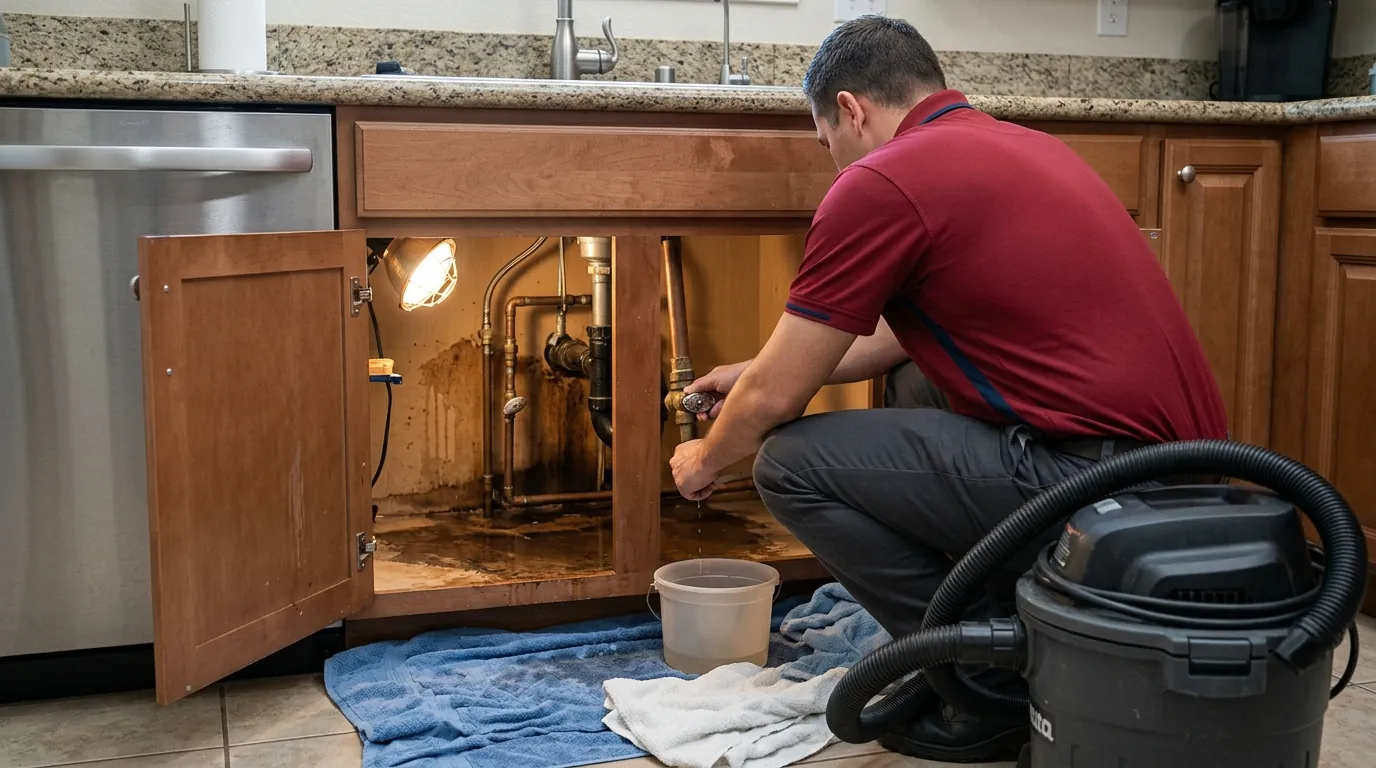
Burst pipe cleanup is not the same as mopping up a flood. The water that escapes a pressurized supply line moves fast and travels far — under flooring, into wall cavities, through ceiling assemblies, and into adjacent rooms before the shutoff valve is ever turned. The visible wet area is almost always smaller than the actual affected area.
The cleanup side of the work involves industrial extraction, structural drying, and continuous moisture monitoring until affected assemblies return to acceptable moisture content — typically measured in wood equilibrium moisture percentage (EMC) and relative humidity readings tracked against IICRC S500 drying goals. The repair side involves identifying the failure point, coordinating the plumbing fix (or performing it where licensed to do so), and then restoring any building materials that were removed or damaged during access — drywall, flooring, insulation, cabinetry.
Equipment on a typical burst pipe job includes truck-mounted or portable extraction units, low-grain refrigerant (LGR) dehumidifiers, axial and centrifugal air movers, and thermal imaging cameras to locate moisture hidden behind finished surfaces. Drying typically takes 3 to 5 days for Category 1 (clean supply line water) losses in standard construction, though concrete slabs, multi-layer flooring assemblies, and dense-pack insulation can extend that timeline significantly.
Our process
-
Emergency shutoff and source control. The first call is always about stopping the water. If the main is already off, we confirm it and begin staging equipment. If it isn’t, we help coordinate with you and your plumber to get the flow stopped before extraction begins — because extracting while a pipe is still flowing is a losing battle.
-
Thermal imaging and moisture mapping. Before a single piece of drywall comes down, we scan affected walls, ceilings, and floors with infrared cameras and calibrated moisture meters. This gives us a documented baseline — where the water actually went, not just where it looks wet — and protects you during the insurance claim by establishing scope with evidence, not guesswork.
-
Extraction and controlled demolition. Standing water is extracted first. Then, where moisture readings indicate saturation behind finished surfaces, we perform targeted flood cuts or material removal to expose wet cavities to airflow. We remove only what the readings justify — not everything in the room.
-
Structural drying with daily monitoring. LGR dehumidifiers and air movers are positioned to create a drying system, not just circulate air. We return daily to log temperature, relative humidity, and material moisture readings, adjusting equipment placement as assemblies dry. Every visit is documented with time-stamped readings — the kind of data an insurance adjuster or independent inspector can audit.
-
Repair scope and reconstruction. Once drying goals are met and confirmed in writing, we coordinate or perform the repair work: replacing drywall, reinstalling insulation, refinishing flooring, and restoring any cabinetry or trim that was removed for access. The job isn’t done when the equipment leaves — it’s done when the room looks and functions the way it did before.
What separates a good burst pipe response from a bad one
The most common mistake in burst pipe cleanup is declaring a structure dry based on surface feel rather than calibrated meter readings. Drywall can feel dry to the touch while the wood framing behind it reads 25% moisture content — well above the threshold where mold becomes a serious risk. Experienced operators log readings at every visit and don’t remove equipment until the numbers confirm drying, not just until the surface looks acceptable.
A second failure point is incomplete moisture mapping at the start. Water follows gravity and the path of least resistance — it travels along floor joists, pools in low spots under subfloor, and migrates horizontally through wall plates. Skipping thermal imaging or relying only on visual inspection means affected areas get missed, dry on their own timeline, and often show up as mold or warped flooring months later.
Insurance adjusters reviewing a burst pipe claim look for a documented drying log, a written moisture map with baseline and final readings, photographs of affected materials before and after demo, and a clear chain of custody from loss date to completion. A claim without that documentation is harder to close and more likely to face pushback on scope.
As an IICRC Certified firm, our documentation follows S500 standards — the same framework adjusters and independent consultants use to evaluate whether a drying project was performed correctly.
Seasonal and regional considerations
Bakersfield’s climate is semi-arid, but that doesn’t make pipes immune to bursting. Winter nights in the Central Valley regularly drop into the low 30s, and older homes in neighborhoods like Oleander, Westchester, and the downtown core often have supply lines running through uninsulated exterior walls or unconditioned crawl spaces — exactly the conditions that produce freeze-related failures. January and February are the most common months for freeze-burst calls in Kern County.
Summer brings a different risk: high attic temperatures cause PEX and CPVC supply lines to expand and contract repeatedly, which can fatigue fittings and joints over time. A slow weep from a fitting in a hot attic can go unnoticed for weeks before it becomes a ceiling collapse.
Service area
ProRestoration Services responds to burst pipe emergencies throughout Bakersfield and the surrounding Kern County area, including Oildale, Shafter, Wasco, Delano, Tehachapi, and Ridgecrest. City-specific pages for each area link back here for full process detail.
If you’re standing in a wet room right now, call (661) 393-9306. We’re available 24/7, and the sooner structural drying begins, the narrower the repair scope stays. Call now to start your moisture assessment and get a documented drying plan in place today.
Frequently Asked Questions
How do I know if the water from a burst pipe is considered Category 1, and why does it matter for cleanup?
What should I do — and not do — while waiting for the restoration crew to arrive after a pipe bursts?
How long does structural drying typically take after a burst pipe, and what affects that timeline?
What does a burst pipe moisture map include, and why do insurance adjusters ask for one?
Can mold start growing from a burst pipe even if the water is cleaned up quickly?
Looking for the best burst pipe cleanup and repair company in Bakersfield?
ProRestoration Services provides licensed and insured burst pipe cleanup and repair in Bakersfield, CA and the surrounding area. We answer calls 24/7 — call (661) 393-9306 for immediate help.
Need Burst Pipe Cleanup and Repair now?
We respond 24/7 across Bakersfield and surrounding CA cities.
Related Coverage
- Our Restoration Services
- Contact ProRestoration Services
- Burst Pipe Cleanup and Repair in Arvin
- Burst Pipe Cleanup and Repair in Bakersfield
- Burst Pipe Cleanup and Repair in Delano
- Burst Pipe Cleanup and Repair in Lake Isabella
- Burst Pipe Cleanup and Repair in Lamont
- Burst Pipe Cleanup and Repair in Oildale
- Burst Pipe Cleanup and Repair in Rosedale
- Burst Pipe Cleanup and Repair in Shafter
- Burst Pipe Cleanup and Repair in Taft
- Burst Pipe Cleanup and Repair in Tehachapi
- Burst Pipe Cleanup and Repair in Wasco