Appliance Leak Cleanup in Bakersfield
24/7 appliance leak cleanup in Bakersfield and surrounding areas. IICRC-certified, insurance billing accepted. Call (661) 393-9306.
A slow drip behind the refrigerator. A washing machine supply line that let go overnight. A water heater that quietly pooled for days before anyone noticed the soft spot in the drywall. Appliance leaks are deceptive — the source is often small, the visible damage looks manageable, and the real destruction is already happening inside the wall cavity or under the subfloor. Bakersfield’s older housing stock, much of it built on slab foundations with tight utility alcoves, gives water almost nowhere to go except sideways into adjacent framing and flooring.
What Appliance Leak Cleanup actually involves
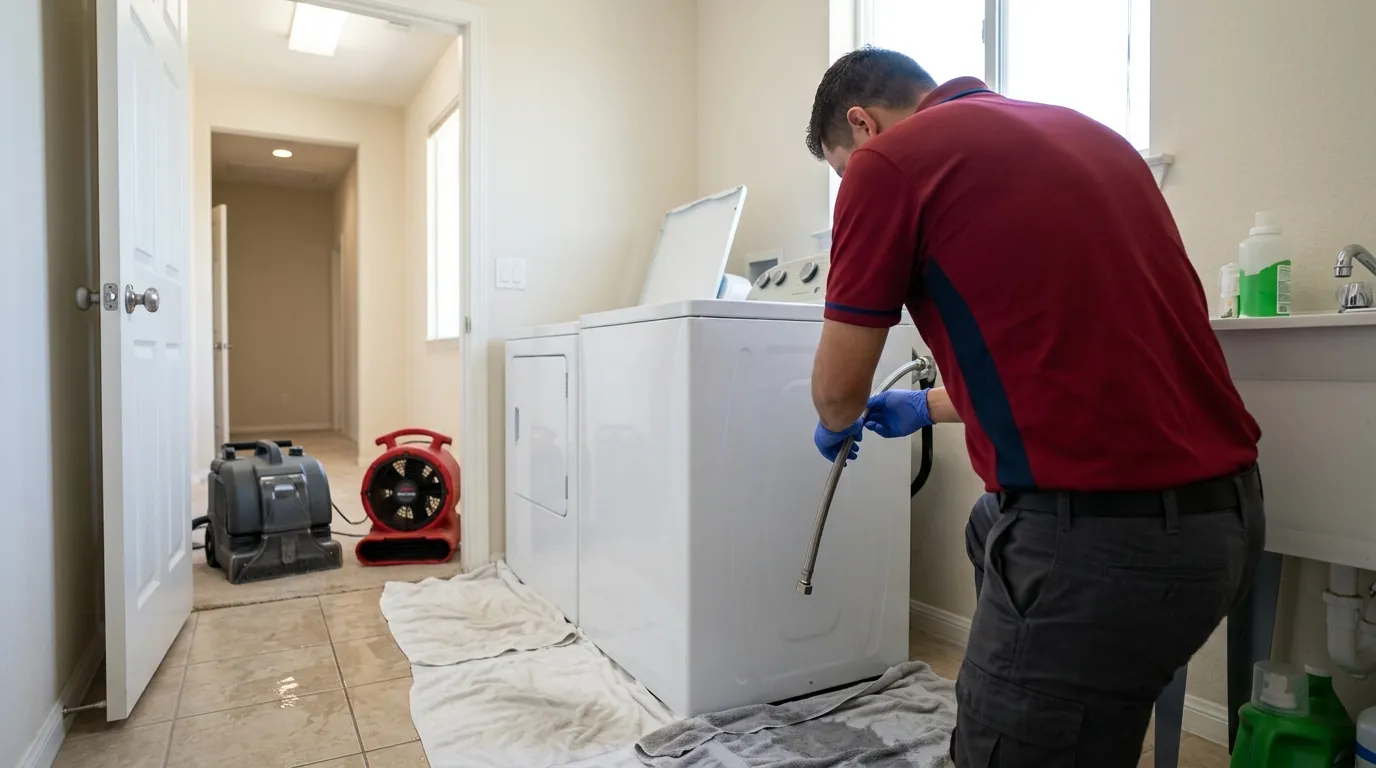
This is not a shop-vac-and-fan job. Appliance leaks introduce water into confined, low-airflow spaces — under dishwashers, behind refrigerators, inside laundry closets — where ambient drying does almost nothing. The work involves locating the full extent of saturation with thermal imaging and calibrated moisture meters, extracting standing water, and then engineering a drying system that moves enough air through those tight cavities to actually drop the moisture content of structural materials before mold colonizes.
Mold can begin establishing within 24 to 48 hours in a wet wall cavity. In Bakersfield’s summer heat, that window shortens. The equipment used matters: refrigerant dehumidifiers sized to the affected area, axial or centrifugal air movers positioned for inward drying on wall cavities, and daily psychrometric readings to confirm the drying system is performing. Drying is documented against the IICRC S500 standard, which gives insurance adjusters a defensible record of what was done and why.
Timeline for a typical appliance leak — a dishwasher that saturated the cabinet base and adjacent toe-kick — runs three to five days of active drying after extraction. A water heater leak that sat for several days before discovery may require controlled demolition of drywall to expose wet framing before drying can begin in earnest.
Our process
-
Source confirmation and water category assessment. Before any equipment is placed, the leaking appliance is identified and isolated. Water from a clean supply line (dishwasher, ice maker, refrigerator water line) is Category 1 — relatively clean. Water heater leaks are also typically Category 1 unless the tank has significant sediment or the water has contacted contaminated surfaces. This classification determines how materials are handled and whether contents can be dried in place.
-
Thermal imaging and moisture mapping. An infrared camera identifies the cold, wet zones behind cabinets, under flooring, and inside wall assemblies that a visual inspection misses entirely. Every affected area is logged with a moisture meter reading so the drying goal is measurable, not guesswork.
-
Extraction and controlled demolition if needed. Standing water is extracted. If moisture readings confirm saturation inside wall cavities or under hardwood or laminate flooring, targeted cuts or panel removal expose the wet material to the drying system. Cabinets with swollen particleboard bases are assessed — particleboard rarely dries structurally sound and often needs to be replaced rather than dried.
-
Drying system installation and daily monitoring. Air movers and dehumidifiers are placed based on the moisture map, not just set in the middle of the room. Readings are taken each day and logged. The system is adjusted if a cavity is not trending toward the drying goal. This daily documentation is what separates a defensible insurance claim from one that gets disputed.
-
Final clearance and scope documentation. When all readings reach dry standard, equipment is removed and a final moisture report is generated. If any materials were removed, the scope document supports the reconstruction estimate.
What separates a good appliance leak response from a bad one
The most common failure in appliance leak cleanup is incomplete moisture mapping. A technician who checks the visible wet area but doesn’t probe the wall cavity behind the dishwasher, the subfloor under the refrigerator, or the toe-kick framing on the adjacent cabinet will leave wet material behind. That material will grow mold. The homeowner will call again in three weeks with a different problem.
A second common failure is drying particleboard cabinet bases in place. Particleboard swells when wet and does not return to structural integrity when dried. Insurance adjusters familiar with appliance claims know this — a photo of a swollen cabinet base with a moisture reading is straightforward documentation for replacement. Trying to dry it and calling it done is a shortcut that creates a callback.
Good operators also distinguish between a supply line leak and a drain line backup. A dishwasher drain that backed up introduces gray water (Category 2) into the same space, which changes how contents are handled and whether porous materials can be dried in place or must be removed.
Seasonal and regional considerations
Bakersfield’s climate creates two distinct risk windows for appliance leaks. In summer, high ambient temperatures accelerate mold growth in wet cavities — a leak discovered Monday morning that might allow a 48-hour response window in a cooler climate may need same-day extraction here. In winter, water heater demand increases and older tank-style heaters that have been cycling hard are more likely to develop slow leaks at the pressure relief valve or supply connections. If your water heater is more than eight years old and you notice mineral staining or rust at the base, that’s worth a look before it becomes a cleanup job.
Service area
ProRestoration Services responds to appliance leak calls throughout Bakersfield and the surrounding communities, including Oildale, Rosamond, Tehachapi, Wasco, Shafter, and McFarland. City-specific pages for each area link back to this page for the full service description.
If you’re standing in a wet kitchen or laundry room right now, call (661) 393-9306 — the team is available around the clock. The sooner the moisture mapping starts, the narrower the damage footprint stays. Schedule your appliance leak moisture assessment today.
Frequently Asked Questions
My dishwasher leaked but the floor looks dry now — do I still need a professional assessment?
What's the difference between a supply line leak and a drain line leak from an appliance, and does it change the cleanup?
How long does drying typically take after a washing machine or refrigerator leak?
Can the swollen cabinet base under my dishwasher be dried and saved, or does it need to be replaced?
What should I do immediately after discovering an appliance leak while waiting for the crew to arrive?
Looking for the best appliance leak cleanup company in Bakersfield?
ProRestoration Services provides licensed and insured appliance leak cleanup in Bakersfield, CA and the surrounding area. We answer calls 24/7 — call (661) 393-9306 for immediate help.
Need Appliance Leak Cleanup now?
We respond 24/7 across Bakersfield and surrounding CA cities.
Related Coverage
- Our Restoration Services
- Contact ProRestoration Services
- Appliance Leak Cleanup in Arvin
- Appliance Leak Cleanup in Bakersfield
- Appliance Leak Cleanup in Delano
- Appliance Leak Cleanup in Lake Isabella
- Appliance Leak Cleanup in Lamont
- Appliance Leak Cleanup in Oildale
- Appliance Leak Cleanup in Rosedale
- Appliance Leak Cleanup in Shafter
- Appliance Leak Cleanup in Taft
- Appliance Leak Cleanup in Tehachapi
- Appliance Leak Cleanup in Wasco
- Burst Pipe Emergency Checklist: Step-by-Step Response